Fraudulent Educational Streamers
Introduction
I really didn't want to make this post, but recently I've been tuning into more and more "educational" streams and have gotten incredibly tilted for one reason or another. I've done some thinking and I've come to the conclusion that the reason I am so upset is because it usually boils down to some sort of fraudulent representation of credentials to some degree.
Background
To some extent it all started back in Hololive and Kureiji Ollie. It is directly quoted in the wiki that
She has hosted math streams in which she discussed university-level topics such as polynomial division, differential equations, and proving that .
Somewhat surprisingly, Indonesia's standard math curriculum is about as backwards as the USA's, but perhaps the only truly university level topics would be derivatives (not differential equations), and the proof that . Polynomial division is taught at an Introductory Algebra II level across many countries, and many countries offer Calculus I as a high school class. So at best, she is just regurgitating some first year undergraduate mathematics to the viewers. Additionally, her "proof" of only summarizes the general idea in Volume I of PM. It contains none of the meat, i.e. what , , or a successor function is. It is in fact, somewhat trivial, to show that , given a theory of natural numbers.
While I think it is admirable that she is bringing attention to mathematics to the general population, I don't think the entire act of putting these accomplishments (mostly equivalent to having a basic education in any country) on a pedestal is correct. Regardless, I don't actually have any problems with Ollie herself, and the fraud is limited to the fraudulent elevation by her audience. It just serves as some random starting point for my rant.
The Present Past
Fast forward to a few months ago, 4-5 years into the future. Streaming has exploded in popularity and there are educational streams aplenty (ok not really, but it is nice to see them here and there). We are fresh off the drama of Areayo being a fraudulent 25 year old MIT PhD graduate, and I catch an educational math stream out of the corner of my eye. Someone is helping high school students with homework problems! This vaguely catches my interest, and we are off to a good start.
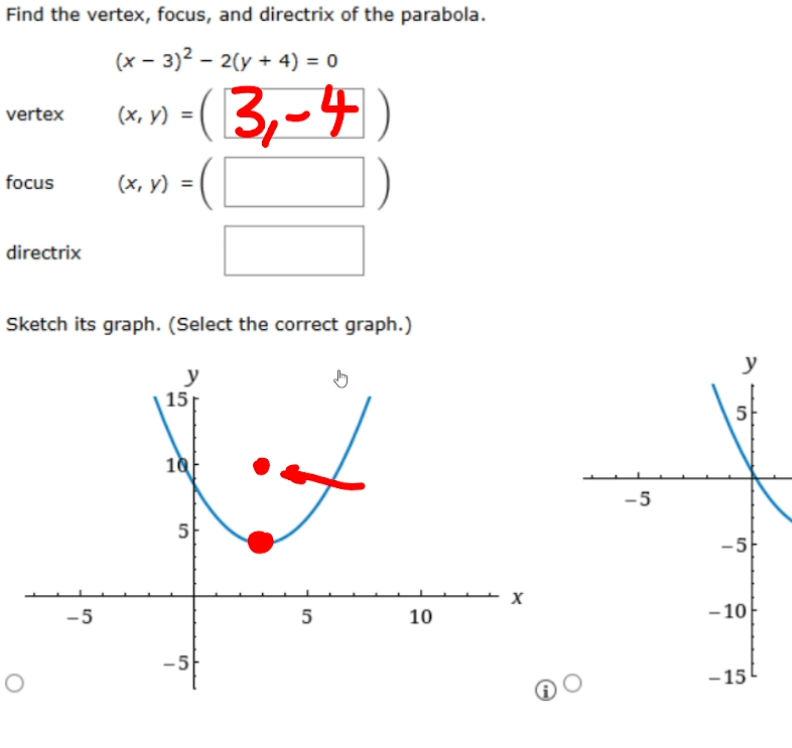
Ok maybe I don't quite agree with the curriculum being taught but it is what it is and the streamer seems to be doing a somewhat decent job. Not bad! Then we arrive at the following problem.
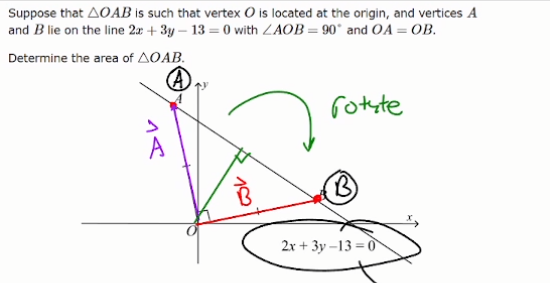
What is even going on here? The streamer is applying rotation matrices to the points and trying to solve a nasty series of quadratics. If we use some geometry, we can recall that the area of this triangle is one half base times height, and because it is an isosceles right triangle, if we let the base be AB, the answer is just the square of the height to AB. Then a careful application of the point line distance formula yields
so our final answer is just its square, . Streamer has just wasted over an hour on what should be a 5-minute problem at the maximum. In fact, when confronted about the point line distance formula, the streamer had never heard of it and was convinced their method, which never finished solving the problem, was superior. If our supposed educators are unable to teach students the most effective ways of solving tedious homework problems, what hope do we have left in education? If we are going to be a good educator, we should at least be humbled when we learn something new, and aim to apply it in the future, especially if it saves time.
This time, although streamer is bringing attention to mathematics, I am very displeased with their methods. The sort of fraudulent behavior where you insist your methods are superior and insist on remaining uneducated is not the look I think educational streamers should mold themselves after.
Present Day
We are now going to veer off topic into the land of programming and computer science, and present what I consider to be the most egregious example. Enter a new streamer, whose qualifications are as follows:
- Occupation: Programmer
- Years of experience: 10
- Stream goals: educational web development, beginner programming tutorials and leetcode
If we were to judge books by their cover, this actually sounds quite good. Prospective students can learn programming topics and solve example problems with presumably a senior developer and gain real world insight into the software industry. However, we are once again very quickly disappointed.
The setting is LeetCode 1089: Duplicate Zeros. Your goal is as follows.
Given an array of integers, for every 0 you encounter left to right, modify
the array by inserting another 0 and shifting everything over to the right,
while keeping the array size fixed. i.e. [1, 0, 2, 0, 3, 4, 5] -> [1, 0, 0, 2, 0, 0, 3] and [1, 0, 2] -> [1, 0, 0]. The goal is to perform this
transformation in-place. Streamer says they want to start off with the naive
forwards approach. That sounds perfectly reasonable. Then we get the first red
flag. Their algorithm, which is summarized by shift all remaining elements then
write, runs in
? Surely a
senior developer easily computes
sized loop inside
sized loop is
, right? Then the second red flag
appears. I suggest writing the output array backwards. This is the optimal
solution, as you only need to write elements that are shifted multiple times
once into their final position, but it takes them multiple minutes to understand
this seemingly trivial strategy of going through an array backwards. This
starts setting off every alarm bell possible in my head.
Fast forward a couple of weeks, and they try to implement a singly linked list
interface, but as a challenge from their usual language, TypeScript, they
decide to do so in C. This is perhaps the most damning evidence. During the
implementation process, we learn that in their ten years of programming, they
have never heard of the term heap allocation nor the function malloc. Now
that, is incredibly surprising, as being in the industry for ten years means
they graduated university around 2015-2016. I guess React did start
getting super popular back then but supposedly if you studied coding at all in
any university during that time period you would have been exposed to at least
one of C or C++ and at least heard of manual memory management,
right? We can also spy on their initial stream, where streamer struggles to
distinguish the behaviors of ++i and i++ in native TypeScript. It also takes
them a minute to recall how [...Array(n)].map iterates over its indices.
Overall, this has the makings of someone who understands TypeScript code but has not spent any significant amount of time doing any sort of algorithms. I guess 10 years of programming is technically correct but my guess is that it is more specifically 10 years of UI component programming, and they are completely new to any sort of standard computer science knowledge or algorithm type programming at all.
Were my expectations too high? The vibe definitely feels more like the streams titled "grinding leetcode", "leetcode practice", or "learning ts by doing leetcode", and not "streamer teaches you typescript". What really threw me over the edge was their OffKai handout resembling a midterm and one of the questions was to evaluate a JSFuck expression, which nobody in their right mind would do. I'm going to be completely honest. I don't think this stream has any capability of teaching besides the viewer learning alongside the streamer, and that goes completely against what I think the stream is trying to present itself as.
Conclusion
In the end, this is just me ranting about what I observe as "the current state of online education content". Of course, there are always better resources, and I don't exactly have any power to police streams, but the overall direction of everything just feels wrong to me. There are more and more AI slop videos re-explaining the same topics over and over again. Actually good educational content is still coming mostly in the form of YouTube videos but those are few and far between. How does all this relate to the literacy crisis as education becomes more and more online? Is this just a stepping stone towards the ideal state or are we slipping off of an unstable equilibrium? Who knows? What I know for certain is that I am not a fan of the current state of things.